
Context of Enquiry
Data pertaining to a city by default feels tangible, and directly associated to the physical space which is indicative of its relationship. Our inquiry questions the strength of this association, from a physical space and data that may represent it.Due to machine learning advances in data mining and manipulation, we interrogate whether it is possible to capture identity of a place with the aid of machine learning applications, and how these interactions may become more tangible.
My contribution:
- Helped conceptualized the idea of capturing of a author’s writing style
- Created Machine Learning models trained on the given literature
- Developed the digital interaction and visualization
Identity and Place
We explored how identity of a place can be constructed through data that is directly associated or “tagged” to the place. In terms of Edinburgh, a city of vast literature wealth, we became interested in in the Palimpsest LitLong dataset. In it, pages of books are geotagged to streets and locations within the city that mention them, offering an augmented experience when traveling through the city. It offers rich depictions of past spatial and cultural identity.
Machine Learning and Style Capture
Machine learning can be used to capture or obscure style. When we talk about images the Next Rembrandt project is very interesting. A group of designers and machine learning experts were able to create a piece of painting based on Rembrandt’s works. The observers were not able to tell whether the piece was lost art of Rembrandt’s ( Figure 1 ).
Equally, neural networks can be used to obscure styles. This is perhaps best demonstrated by Google Deep Dream, where the network is trained to look for a certain feature, (for example eyes), and then we look through from the network’s perspective to see what it interprets within an image.


Figure 1. The next Rembrandt and Google Deep dream.
Recurrent Neural Networks
The concept of neural networks is in many ways analogous to how our brains work. A neuron receives a signal, changes this signal and then passes it on. Neural networks can contain thousands of these neurons. In this case we focused on character based recurrent neural networks. Character based networks work well with text, slowly learning about rules within it, whether it’s spacing or general English. These networks look at one character at a time, but this is where the recurrence comes in; they also have a memory of what characters they have seen in the past, allowing them to reproduce words and sentences.
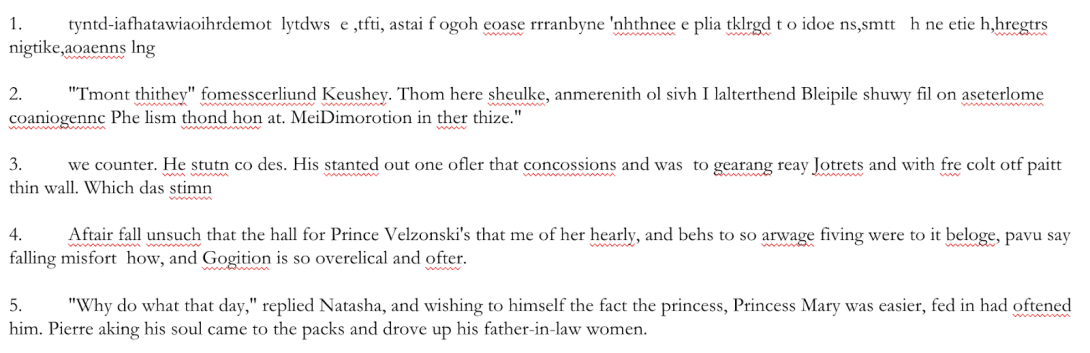
The training of a character based recurrent neural network.
Design Opportunity
The aim of this project was to explore identity or rather personality through machine learning techniques to capture literary voice.
Equally we attempted to construct an engaging interaction inspired by the exquisite corpse abstraction game [2].
Capturing personality through machine learning
Our initial tests with feeding corpus’ of text into the neural networks yielded mixed results.
We realised that to capture a satisfying level of personality or character, our dataset would need to contain literature of similar subject matter or be written by the same author.
Drawing on the idea of sociological concepts being pinned on to AI systems, such as speaking about them as a ‘non-anthropolical other’, we wanted to choose texts that spoke of otherness and groups of people that had been othered within the city. We equally explored the different ways things become tagged to a place and become part of its identity. Therefore we chose to train our neural nets on the following groups of texts:
- – The writings of Irvine Welsh: Edinburgh born novelist whose novels often speak of subcultures within Edinburgh
- – Writings on ‘Queer Theory’ published through Edinburgh Universities research gate
– Texts recommended by the Scottish Pagan Society
Practice
Three different neural networks were trained on the books and articles each representing their concept. When the user entered the start of a co-authored book it was processed by all three networks running on a laptop. The results were projection-mapped onto the physical representations of the books (Figure 2).
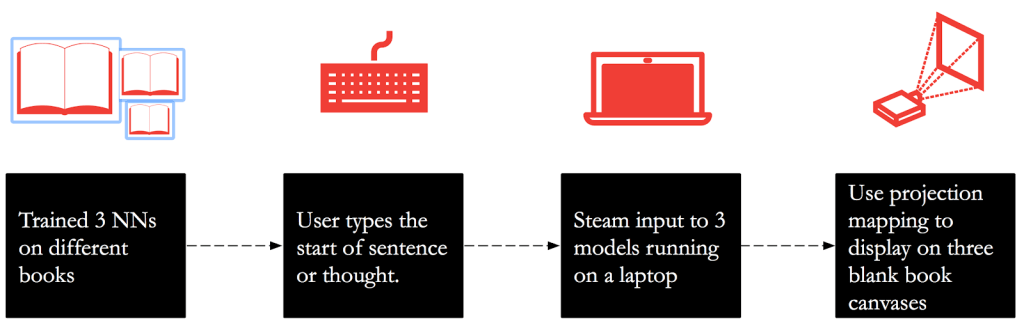
Figure 2. Flow of interaction.
Exhibition
We felt the setup and style worked well as the interaction between the exhibit and different users raised interesting questions about filter bubbles. There were also several knowledge gaps and curiosity in general pertaining to the machine learning method applied, character recognition, as this produced redundancies between quite different inputs.
Equally in terms of identity, we began to debate about to what extent books and literary voice represent a place. The degree to which a book has the Edinburgh-ness to it and particularly streets that are mentioned once within a book, which made these questionable in deeming worthy of it being a direct representation of the city. The Palimpsest datasets offered books that were tagged to specific places, but contextually lacking a direct relationship to them. These debates made us more interested in the data that is the intellectual property of every person who lives on a street. People’s use of social media and location services being part of that data begins to create stories within these spaces, granting which can be regarded as a layer of contemporary socially crafted identity.
References
[1] Fischer, Gerhard. (2012). “Context-aware systems: the ‘right’ information, at the ‘right’ time, in the ‘right’ place, in the ‘right’ way, to the ‘right’ person.” http://dl.acm.org/citation.cfm?id=2254611
[2] Breton, André. (1948). Le Cadavre Exquis: Son Exaltation , La Dragonne, Galerie Nina Dausset, Paris.
 Fabien Florek